


| About Wyble Family History
Please sign in to see more. Information can be taken from this site but no information can be incorporated or sold for profit. Copyright January 16, 2008. Registraton Number: TXu 1-618-109
PLEASE SIGN MY GUEST BOOK UPON COMPLETION
German Immigration
In the Early Catholic Immigration to New Jersey Iron Mills, The Palatine Immigrant, vol. XVI, no. 1 (Spring 1991_; The Weibels are a great dynasty of Hammersmiths (*) whose home is South Germany. A Bernard Mayhle, who is researching Phillipp Fichter indicates that Phillipp Fichter worked at Ringwood and Long Pond at the same time as Carl Weibel. He mentioned that a list of his ancestors occupation as Hammerschmeid.This term can be translated directly as Hammersmith, but also means Blacksmith and, more likely in this context, Forgeman or Hammerman at an Iron Forge.
The origin of Ringwood's name is thought to have been selected because the location is "ringed" with wooded hills; or it might have been taken from our present sister city, Ringwood, Hampshire, England. Ringwood is located in the heart of the Ramapo Mountains at the eastern end of New Jersey. It is known as the Highlands and contains what geologists consider to be the oldest rock formations in the world.
Sometime around 1740, Cornelius Board, a Welsh miner who had erected a small furnace on Sterling Pond, New York, and the Ogdens of Newark, each purchased land in Ringwood. While the Boards' operation was small, the Ogdens erected a furnace in 1742 and thus became the first volume producers of iron in this area, importing over five hundred workers from Germany and England along with native whites, both free and slave Black people, and an occasional Indian.
Excerpts of the Johann Herbergs diary noted on the 20th of September 1764, the miners arrived at Philadelphia as did Mr. Hasenclever himself from New York. Notes from "The Forgotten General" by Robert Erskine reflects Copper had been discovered in the neighborhood of Belleville prior to 1720. Therefore, mining started as early as the 1700's in the region. The remarkable Case of Peter Hasenclever, Merchant cites that the German Workers and Families started arriving in the autumn of 1764.Hansenclever started making iron in November of that year. The buildings to house the workers and families were started in May 1765 and November 1766. It also references Hasenclever sailed into and out of New York on two separate occasions. If this is so, then the workers may have also sailed into New York, old Manhattan that speculation had surfaced. Nevertheless, no one is sure which port they arrived at date.
In 1752 Father Farmer, alias Ferdnand Steinmeyerr, a Jesuit from Weissenstein in Wurttemberg, came to Philadelphia. From 1755 he visited his flock of Catholics in New Jersey administering Holy Communion, Baptism, and marriages, etc. Father Farmer died in 1786. However, his baptismal, matrimonial, and other records have been well preserved and published. Names mentioned by Father Farmer were familiar to Walter Petto, who studied the Germans who worked at the early iron mills in the Saarland, the Palatinate, the Mosel and Husruck area, in Alsace and the German -speaking portion of Lorraine, France who set out for New Jersey. Records for these Germans end in Europe in 1765 and begin in New Jersey in 1766. Petto indicates that the immigrants came from the Idarwald, a wooded ridge between the Mosel and Nahe Rivers. Carl Weibel, from Nunkirchen and Johannes May from Langweiler were of interest to my search for the roots were mentioned in his findings.
Baron Hasenclever had his nephew Anton Hasenclever to recruit German miners, iron smelters, hammermen, charcoal burners and carpenters for work in the colony. Many workmen responded to and in the autumn 1764 and the following spring 535 men, women and children arrived in New York to work at the furnaces. As early as the 1700's the original name had its variations. Susan Maier of the Friends of Long Pond contacted me and state she had several Wyble's that were found during here research. They were Charles and Susanna Weibl; Conrad and Julianna, Catherine Waibl and William Mullen: Charles Waibl; Magdalen Waibl and James May; Margaret Waibl and John Anthony May and finally Susanna Waibl. I hope with continued research and assistance of relatives and friends to compile a history that will be both informative and enjoyable to read.
VARIATIONS IN THE SPELLING OF THE WYBLE NAME
Waibl, Warble, Wayble, Waybel, Webel,Weeble, Weibl, Weibel, Weible, Weyble, Wible, Wibolde, Wiyble, Wyble, Wyler
Occupations frequently follow names in German records. This is to distinguish one man from another, since there are frequently two people with the same given name in a town. Therefore, Hammersmith following Georg Webel's name is his occupation.
All information is gathered from many sources. Before you submit any info have sources and verification. I have taken pride in this research and have to the best of my ability verified and cross-referenced. If you find any errors, mistakes and/or additions please submit with source. Any information and pictures are greatly appreciated.
The Wyble name in its various spellings still may have some from the Germanic compound personal name beginning with wig war, battle. One referenced the Americanized spelling of WEIBEL.
Another source states the surname is of patronymic origin. Patronymic names are surnames that derive their origin from the first name of the father of the initial bearer. In this instance, the surname Wyble drives from the Germanic name WIBO, which in turn derives from the Gothic "Weihan" Old High German "Wigan" meaning Fight. Alternatively, the name is of occupational origin, deriving from the trade or profession of the original bearer. In this instance the name derives from the German occupation name WEIBE? meaning an "official messenger." The Waibel or Weibel was usually employed by a village or city to deliver official documents. Occasionally, the name is of nickname origin, deriving from a personal or physical characteristic of the original bearer. Here, the name derives from the southern German dialect word for "wife". Researching also indicates that the name could also derive from the German word Weibel meaning to move back and forth, to wave.
The surname Wyble and its variants can be found in documents dating back to the thirteenth century. Burcardus qui Waibil was a resident of Lellwange, near Ueberlingen in the year 1200. One Burcard dictus Waibil was a resident of Falkenstien o the year 1204. Ella dicta (called) Wibelin was a resident of Sachsenheim, near Vaihinagen in the year 1330. Jakob Weybe was a resident of Frankfurt in the year 1384. Documents for the year 1484 indicate one Els Wyppin was residing in Ravensburg. One Hans Wabel was a resident and citizen of Kemphen in the year 1579. One Jean Weibel was a resident in Murten in the eighteenth century.
Of course, all the Family Name History is considered conjecture but still makes our lives interesting as we continue to research our roots.
Research has indicated that the Weibels were a great dynasty of hammersmiths whose home was South Germany.
It is documented that Carl Wibel as a fellow Phillip Joseph Fichter must have heard of Hasenclever's enterprise in NJ. An Elizabeh Weibel who was a sponsor at Ringwood June 21, 1857, appears to be George and Anna Dorothea Weibel daughter b 13.02.1720. More on Phillip Joesph Fichter. He was baptized September 28, 1719, at Fischbach, near Dahn, Palatine as son of Claudius Fichter, forge master at nearby Schonau hammerworks and of Catherine. The couple came to Schonau about 1710 and had at least eight children. Philipp Joseph married at Trippstadt near Kaiserslautern, February 13, 1746 Elisabeth, daughter of the late Wilhelm Dorh. As a hammerman Philipp Fichter moved from fore to forge in the French-German border Some of his children were born the following dates and places: 1746 Schonau, Dec 17,1747, Schonau, June 19, 1751, Scheidt, Saarland, December 24, 1753, Outerhouse, Lorraine, November 21, 1755, Geislautern, Saarland and the last March 21, 1757, Nunkirchen Saarland. At Nunkirchen Phillipp lost his first wife in 1758. He married then a Wadern Eva Fett. They had three more children in Germany 1761 Nunkirchen, 1762 Nunkirchen and December 1763 Nunkirchen. Five other children were born in Ringwood Long Pond, NJ., between 1767 and 1774.
During my research there has been Two Conrad Wyble's always in question where they came from, whose family did they belong too, and who are their Parents. Numerous sites have both Conrad's different spouses, children but with the same Parents. After finally contacting one descendant of Conrad Wyble and Jane their son's Anthony's line we had DNA tests compared to my Conrad and Julianna May/Meys. The results showed different Ethnicity, but even direct relatives can show the same. What was discovered distance relatives matched between us. This in itself shows a connection between us.
The legend of the above Conrad was that he was born aboard ship coming over to the colonies may have merit. The facts are Conrad Weibel/Wyble was baptized 14 Mar 1766 a second time in Ringwood, New Jersey (the first time in a private ceremony) which has been fully documented by several sources. Here I will provide my research on Conrad to date.
1766 14 March born Conrad son of Charles Weibl and Susanna Mohr in Ringwood/Long Pond, New Jersey. Baptized March 19, 1766, by Father Farmer. Sponsors, Conrad Welch, and Catharine Demuth has been baptized privately; ceremonies supplied. Ibid. (Doc# 2 ,12 & 24) 5th GGF
1778 May, John of James, and Magdalen Wyble May, born June 20, 1778, baptized October 4th, sponsors John Cobole and Julianna May. (Doc# 26)
1779 May Conrad, of Anthony and Margaret Wyble May, born March 23rd, 1779, baptized April 25th, sponsors Conrad Waibel and Julianna May. (Doc#26)
1779 May Mary Catharine, of James and Magdalen Wyble May, born October 24, 1779, ceremonies supplied June 9, 1780, sponsors Conrad Waibl and Catherine Wyble May. (Doc# 26)
1783 26 May Conrad Waibl at Ringwood married Julianna May born 4 October 1762 Langweiler, Germany. Julianna daughter of a large family. Proceeding administrated by Father Farmer. Witnesses; The bridegrooms Father and mother and Brides brothers. (Docs# two & 13) Note: The isolation and infrequent visits of the priest also created some difficulties with regard to marriage. Father Farmer married seventeen-year-old Conrad Waibl (whom he had baptized in 1766) to Julianna May, daughter of a large family at the Ringwood furnace. At the same ceremony, he baptized their three-month-old daughter, Susanna. (Doc#28)
1783 24 February born Susanna Waibl, baptized May 26 at Ringwood ibid; to Conrad and Julia (May) b. 04.10.1762. Juliana May daughter of Johannes May/Mey and Juiana Gerson married 1760 in Langweiler Sponsors, Charles Waibl and Susanna, his wife. (Docs# 4, 13, 14)
1783 According to the U.S. Federal Census, Conrad Waibl moved his family to Orange County, New York, sometime between 1783 and 1790. (Doc# 17) Note: Orange County/ Rockland County New York and Ringwood/Long Pond, New Jersey were within a reasonable distance of travel.
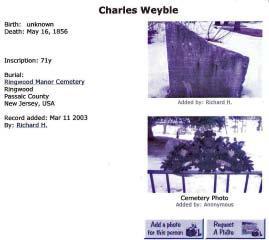
1785 17 May born Charles Weyble died May 16, 1856, Buried Ringwood Manor (Doc#1) son of Conrad and Julianna Waibl, Ringwood, baptized conditionally October 30, ibid; Sponsors Charles Waibl and Elizabeth Welch. (Doc# twenty-two & 24)
1786 20 October Conrad Wibale, claim for patent of a farm purchased by him from Joshua Martin, lying between the old New Jersey lines commonly called the Gore. (Doc# 5)
1787 3 August born John May Wyble son of Conrad and Julianna Wyble, NY. (Ref: ????????)
1790 Federal Census Coonrod Wyble Orange County, New Cornwall, New York with Family (Doc# 10) 2 Males sixteen years and upwards including Heads of Families -ID’d Conrad as One born 1766 3 Males under sixteen – ID’d Charles born 1785 – John born 1787 – Anthony born 1790 3 Females including Head of Families- Id would Julianna born 1762 – Susanna 1783
I had the St. Joseph Church Archives research their records and they provided additional information on the family. Interesting to note Assistant Archivist mentioned that The Records did not have a transcript of entries for the years 1787-1790 as the register could not be located. A later piece in the Records notes that the missing records were found in 1905 included the Bapt records of 1787-1790, as well as marriage records but cannot be located and the register was never transcribed. They also stated they do not have a copy on microfilm. (Doc# 7)
1792 4 Sept Weible, Ringwood, Elizabeth, born Conrad and his wife Eugunia, (Note Eugunia and Julia must be one in the same because Conrad and Julia have another child in 1794 below), Catholics, sponsors William Mullen and Elizabeth Wyble May 4th Great Aunt), Catholics. (Doc# 16 )
1794 8 March born Jacob Weibell son of Conrad and Julia Weibell, baptized second sponsors Jacob and Magdalen May (Ref: 15) (Magdalen Helena Waibl (My 4th GG Aunt) b.2-11-1756 married James Jacob May 05-21-1773) (Doc# 15 )
1796 3 Oct Weibell, Conrad same Parents; bapt. Second sponsors Conrad and Catharine May. Doc# 15) (Catharine May is identified as Mary Catharine Weibel (My 4th GG Aunt) b. 10-24-1779 daughter of Karl and Susanna Weibel) (Doc# 15)
1799 Conrad Weyble shows up in the Tax Assessment Rolls in Cheesecock, Orange, New York. (Doc#28)
1800 Federal Census Coonradt Weible. Town of Cheesecock, Orange County, New York. (Doc# 8) 2 Males under 10 ID’d Jacob born 1794 - Conrad born 1798 3 Males 10-16 ID’d Charles born 1785 - John 1787 - Anthony 1790 1 Male 26-45 ID’d Conrad born 1766
1 Female under 10 ID’d Elizabeth born 1792
1 Female 26-45 ID’s Julianna born 1762 1810 Census New York – Not found in but a document located in the US Post Office listed letters dated October 1820 not picked up. (Doc# 11)
It appears between 1786 and 1800 Conrad and family lived in Orange County the last in the Town of Cheesecock. The Town of Monroe was organized in 1799 under the name of Cheesecock, that being the name of the patent upon the territory of which the town was located. By an act of Legislature passed April 2, 1801, the name was changed to ‘Southfield’. Also noted Rockland County separated from Orange County in 1798. A deed in the Orange County land records for land that was sold in Cheesecock, Orange County in Dec 1805 shows it remained in Orange County.
I researched FHL Film 947105 Abstracts and indexes Books 1-16 v. 1-2 1674-1785 but found no Wyble’s or various spelling. (Doc#30)
1820 Federal Census Conrad Wibel Ward 8 New York (Doc#9)
2 Males to age 10
1 Male 10-16
1 Male 45 and Up
2 Female to age 10
1 Female 16-26
1 Female 26-45
1 Female 45 and up
1829-1830 – Conrad Wybil listed in the Manhattan New York City Directory Occupation Combmaker. (Doc# 25)
Cannot located Conrad in the following year Census 1830, 1840, 1850, 1860 or 1870.
1870 A Conrad Weibel was originally interred at the Snake Hill Cemetery in Seacaucas, New Jersey (Old Potters Field). The cemetery was uplifted to Maple Grove Park, Hackensack Bergen County, New Jersey. This information was received from Richard H. at Find a Grave Web Site. This area is within the confines of where Conrad lived and worked. Some suggest this maybe our Conrad. I question this due to the research, the period on the grave site which doesn’t seem to match. However, the death cited was in 1881 and this Conrad died in a Penitentiary. Could the date be wrong? Could this be our Conrad?
I refer to the Bio on James Harvey Wyble below:
James Harvey Wyble Scanelli’s New Jersey First Citizen (1917-1927) Vol I-IV footnotes Conrad Weyble lived to be 104 years of age. The ancestors on both sides of the family came from Holland. (Doc# 23)
I will continue to research and utilize DNA and other sources to finalize my findings. If you have any questions and/or wish to provide evidence etc., feel free to contact me. |

Wyble Family History

